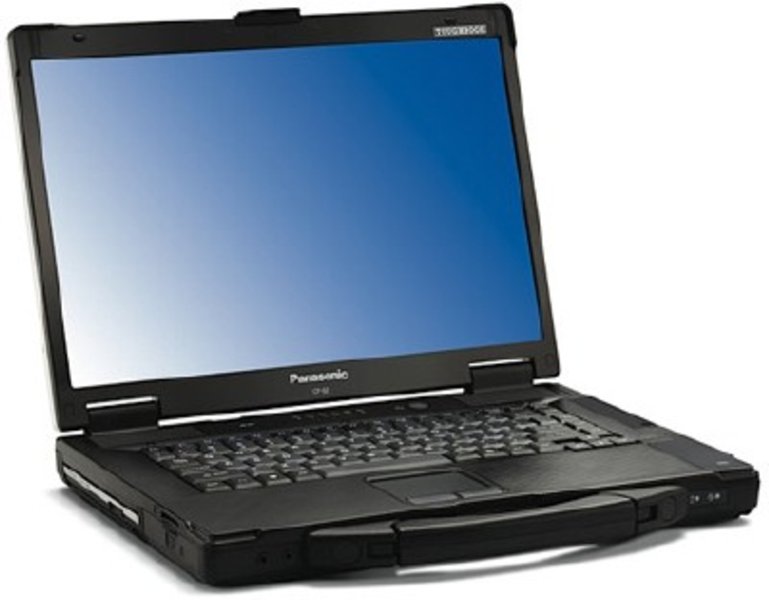




Panasonic Toughbook CF-52
Especificações do Portátil
Price comparison
Média de 6 pontos (das 9 análises)
Análises para o Panasonic Toughbook CF-52
Origem: Techradar
 EN→PT Archive.org version
The Panasonic Toughbook CF-52 combines a clutter-free design with a high level of rugged protection. This isn't a machine for the casual user, but for those who need to work in less conventional areas, it's highly practical and more than user-friendly.
4 von 5, Leistung gut, Mobilität gut, Ausstattung schlecht
Análise única, Disponível online, Curta, Data: 07/29/2008
Pontuação: Pontuação total: 80% desempenho: 80% características: 40% mobilidade: 80%
Origem: CNet
EN→PT Archive.org versionThe Toughbook CF-52 is a solidly built 'semi-ruggedised' laptop with a hardened outer casing, shock-mounted hard disk and covered ports. However, this heavy system isn't the most portable and its battery life falls a long way short of Panasonic's claims.
7 von 10, Display gut, Mobilität sehr schlecht
Análise única, Disponível online, Média, Data: 07/03/2008
Pontuação: Pontuação total: 70% pantalha: 80% mobilidade: 30%
Origem: Laptop Mag
EN→PT Archive.org versionThis well-equipped Toughbook can handle its share of abuse and is a solid performer for the price.
There's a lot to like about the Panasonic Toughbook 52 ($3,093). A stunning widescreen display, better-than-average graphics, and a generous array of ports make this an excellent choice for those requiring a durable road-ready notebook. At 7.4 pounds, the system is a bit on the heavy side, but a sturdy built-in briefcase-style handle makes the Toughbook 52 easy to carry. The 15.4-inch widescreen display is a thing of beauty, delivering crisp, high-resolution (1920 x 1200) images with excellent viewing angles. There was some loss of color definition when we viewed the screen in direct sunlight, but it was still readable.
4 von 5, Display gut, Leistung gut, Mobilität mangelhaft
Análise única, Disponível online, Curta, Data: 12/10/2007
Pontuação: Pontuação total: 80% características: 80% pantalha: 80% mobilidade: 50%
Origem: PC Mag
EN→PT Archive.org versionWith its Toughbook line, Panasonic has a long-standing tradition of supplying its customers with tough-as-nails laptops and a military approach to design, which may be viewed by many as too conservative. The company hopes to inject more consumer appeal without sacrificing the semi-rugged look with the Panasonic Toughbook CF-52 ($3,300 street). For one, it has moved to a widescreen format. It also comes with the latest processors from Intel and discrete graphics from ATI, whereas previous Toughbooks used slightly older technology than their competitors. Sure, the price tag on my test systems is intimidating, but if you can do without all the costly options, the CF-52 can be a huge asset in harsh environments.
There aren't many laptops that have an attached briefcase handle, let alone a comfortable one like that of the CF-52. In order for Panasonic to accomplish this, the framework and exterior molding have to be very durable.
4 von 5, Preis/Leistung mangelhaft, Mobilität herausragend
Análise única, Disponível online, Média, Data: 10/16/2007
Pontuação: Pontuação total: 80% preço: 50% mobilidade: 95%
Origem: CNet
EN→PT Archive.org versionRuggedized laptops have a lot in common with the Hummer business model. They started out as strictly utilitarian machines built for heavy industrial use, but over time, the general public became enamored with the tough-as-nails design, and more consumer-friendly versions of these products made their way into the marketplace. Panasonic's CF-52 is a prime example of that crossover. While it has the bulky militarized look of a truly rugged laptop, it is, in fact, what one would call a semirugged system--offering somewhat increased protection at a more reasonable price and weight. But don't take that as a knock against the CF-52. Truly rugged systems are incredibly heavy and expensive, and suitable only for the most extreme situations. Most users who want extra protection for outdoor or light industrial use need a semirugged system such as this one, which offers the latest Intel Santa Rosa chipset, plus a spill-resistant keyboard and a heavily shielded body.
(von 10): 7.1, Leistung 6, Mobilität 7, Ausstattung 8
Análise única, Disponível online, Média, Data: 08/28/2007
Pontuação: Pontuação total: 71% desempenho: 60% características: 80% mobilidade: 70%
Origem: Chip.de
 DE→PT Archive.org version
Análise única, Disponível online, Curta, Data: 11/21/2007
Pontuação: Pontuação total: 83% desempenho: 76% características: 70% pantalha: 68% mobilidade: 100% processamento: 80% ergonomia: 91%
Origem: c't - 22/07
Comparação, , Longa, Data: 11/01/2007
Pontuação: desempenho: 70% pantalha: 90% mobilidade: 90% processamento: 90% ergonomia: 70% emissões: 70%
Origem: Notebook / Organizer / Handy - 11-12/07
Análise única, , Comprimento Desconhecido, Data: 10/10/2007
Pontuação: preço: 80% desempenho: 80%
Origem: PC World Italia
 IT→PT Archive.org version
Análise única, Disponível online, Curta, Data: 07/15/2008
Comentario
Intel Graphics Media Accelerator (GMA) X3100: Intel Graphics Media Accelerator (GMA) X3100 é um chip de vídeo integrado (incorporado) num chipset de Mobile Intel 965GM (para Merom =Core 2 arquitetura). É a sucessora da GMA 950. O mais interessante é a integração de um pipeline completamente programável. Devido à integração de características Direct X9, HDR e Hardware Transform & Lighning (T&L) – sua predecessora só tinha Software T&L – deveria estar pronta para Windows Vista Premium (suporte Aero Glass completamente). Com respeito aos dados, o desempenho deve ser claramente melhor al de GMA 950.
Muitos jogos são dificilmente executados com estes adaptadores gráficos ou se executam muito lentamente.
>> Mais informação pode ser encontrada na nossa Comparativa de de Placas de Vídeo e a Benchmark Lista.
Intel Core 2 Duo: Este é o sucessor do Core Duo e o Core Solo com um pipeline mais longo e com 5-20% a mais de velocidade sem maior consumo de energia. Adicionalmente ao design do Core Duo existe um quarto decodificador, uma unidade SSE ampliada e uma unidade lógica aritmética (ALU) adicional.
Os Core 2 Duo para notebooks são idênticos aos processadores Core 2 Duo para desktops, mas os processadores para notebooks trabalham com tensões mais baixas e um Frontside bus clock mais baixo. O desempenho de notebooks igualmente clocked é 20-25% mais baixo que PCs Desktop por causa do Frontside bus clock mais baixo e os discos rígidos mais lentos.
T7100:
>> Mais informação pode ser encontrada na nossa Comparativa de Processadores Móveis.